

Commentary
Alexandra Prokopenko
{
  "authors": [
    "Alexandra Prokopenko"
  ],
  "type": "commentary",
  "blog": "Carnegie Politika",
  "centerAffiliationAll": "",
  "centers": [
    "Carnegie Russia Eurasia Center",
    "Carnegie Endowment for International Peace"
  ],
  "englishNewsletterAll": "",
  "nonEnglishNewsletterAll": "",
  "primaryCenter": "Carnegie Russia Eurasia Center",
  "programAffiliation": "",
  "regions": [
    "Russia"
  ],
  "topics": [
    "Domestic Politics",
    "Economy",
    "Security"
  ]
}
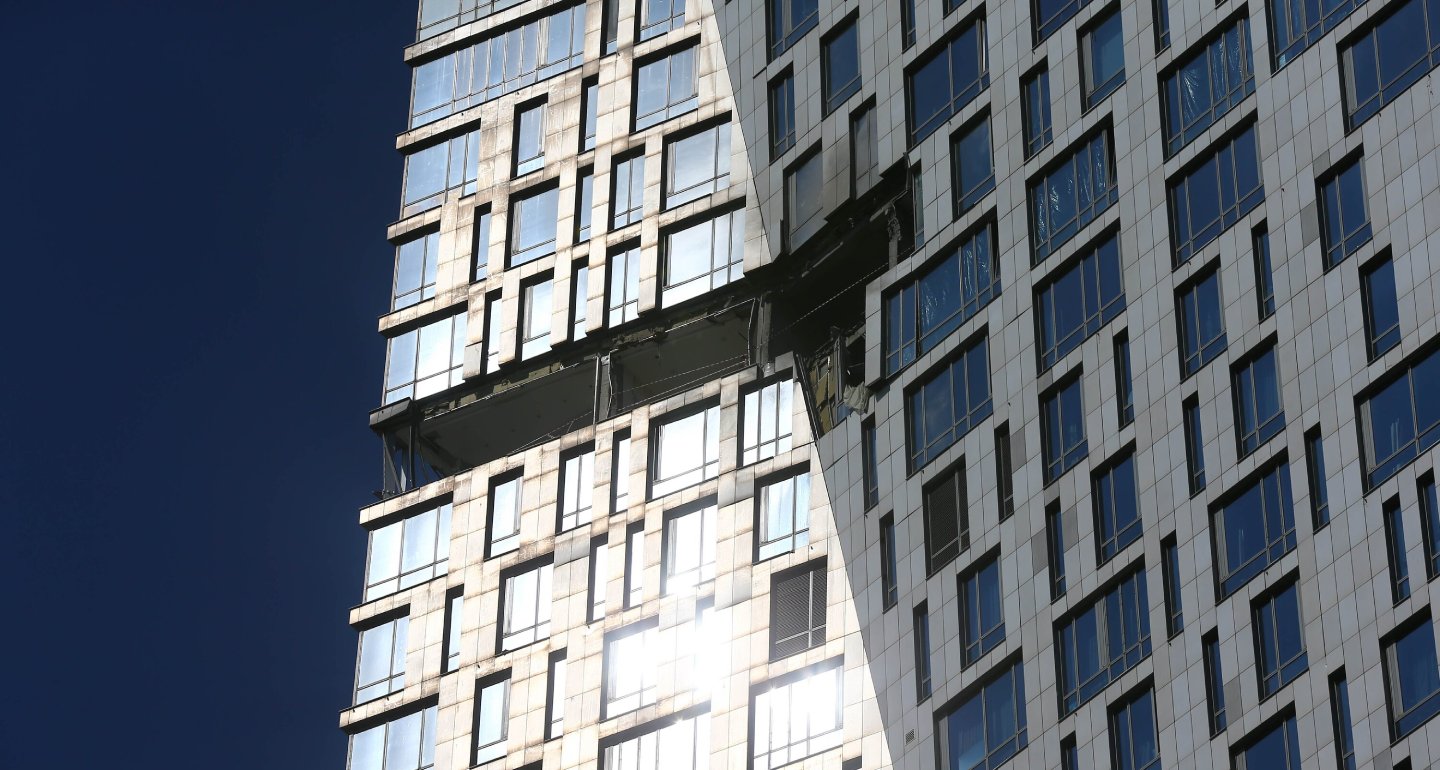
Source: Getty
The cost of air defense has become an unregistered tax on revenue for businesses. While military rents are consolidated in the federal budget, the costs of defense are being spread across the balance sheets of companies and regional governments.
The cornerstone of the historical agreement between a ruler and the population is that the state provides protection from external violence. People and companies pay taxes in exchange for the state keeping them—and their property—safe.
In today’s Russia, that’s no longer the case. Amid increasing Ukrainian drone attacks inside Russia, the regime has shown itself to be incapable of providing security—even for President Vladimir Putin’s sacred annual Victory Day parade, which this year was a drastically pared down version of previous events. Meanwhile, the Finance Ministry has refused to make large businesses’ expenses on defense from drone attacks tax deductible. The Kremlin has started a war and then left businesses to pay for air defense out of their own pockets.
Over the last two years, Ukraine has drastically ramped up its drone attacks against Russian territory. It has gone from using single drones to salvos combining various types of UAVs and cruise missiles.
Such attacks have brought operations at key oil refining facilities to a halt in April and May 2026: a series of strikes targeted Rosneft’s Tuapse Oil Refinery on April 16, 20, 28, and May 1, resulting in a fuel oil spill into the Black Sea and the declaration of a regional state of emergency; attacks disrupted operations at Lukoil’s Permnefteorgsintez refinery on April 30; and a volley of twenty-nine UAVs was launched at the Surgutneftegaz refinery in the Leningrad region on May 5.
The Security Service of Ukraine claims that about 160 effective strikes were carried out against the Russian oil industry in 2025. At certain points, Ukrainian attacks knocked out 17 percent to 38 percent of Russian oil refinery capacity for several days at a time.
Of course, that is not the same as a real drop in production, but losses are losses: they include the time factories are left standing idle, the cost of repairing damaged equipment, and the product that has gone up in flames at oil depots.
Back in April 2024, after attacks on the Taneco oil refinery in Tatarstan and a drone factory in the Alabuga special economic zone, the head of the republic, Rustam Minnikhanov, told industrialists that they should not expect protection from the state. “We have to deal with this using our own resources: every enterprise, every municipality, every city. Wake up, guys, no one will protect us but ourselves,” he said.
Big businesses have subsequently tried to get the government to at least deduct the new expenses from their tax liability. In August 2025, the head of the Russian Union of Industrialists and Entrepreneurs, Alexander Shokhin, asked Putin to reimburse companies 50 percent of the costs of drone defense, allow excise tax deductions, and expand the federal investment tax deduction.
The Finance Ministry rejected all of those proposals, arguing that expenditure on drone defense is of a “one-off and individual nature.” Not content with that position, the authorities are even discussing the idea of making it a legal requirement for energy and infrastructure companies to protect themselves from drones—at their own cost.
Russian companies spent about 100 billion rubles on drone defense in 2024, and likely double that in 2025, according to the National Technology Initiative. Defenses are often makeshift, since companies do not have access to military air defense systems. At the Taneco refinery, one drone was stopped in April 2024 by metal cables stretched over a distillation column, while Bashneft has erected mechanical nets over its processing units.
This forced self-sufficiency is a significant shift in the relationship between business and government. Protecting industrial sites from air attacks is in the public interest, and has always been a state monopoly. Now business spending on air defense, electronic warfare, and perimeter security has effectively become a new, unregistered tax on revenue.
At the same time, the state continues to collect standard taxes used to fund its war, like the mineral extraction tax, VAT, and export duties. What’s more, these taxes (and various other fees) go up practically every year. In 2023, the mechanism for calculating the mineral extraction tax to be paid by oil companies was changed; in 2025, the corporate profit tax was increased by 5 percentage points; and at the start of this year, VAT went up 2 percentage points. While military rents are being consolidated in the federal budget, the costs of defense are being spread across companies’ balance sheets.
In theory, insurance should mitigate business losses, but insurance against the dangers posed by drones is ineffective and only becoming more so. The Russian property insurance market for acts of terrorism and sabotage was estimated at 25–40 billion rubles in 2025, with losses in this segment exceeding 100 percent. Property insurance payments increased by about 30 percent in 2025, according to the central bank, reaching 164 billion rubles.
In 2025, the Supreme Court ruled that because a state of war has not officially been declared in Russia, Article 964 of the Civil Code on force majeures does not automatically apply. In the case in question, it meant that the insurer was obliged to pay out compensation for damages from shelling and drone strikes.
The ruling ensured the legal protection of insured parties, but in economic terms, it destroyed a segment of the insurance market. Insurers are being asked to pay for a war that doesn’t officially exist. Accordingly, insurance against drone attacks is being excluded from standard policies and relegated to separate, more expensive contracts. That is pushing up prices, and in some cases, people are simply no longer taking out property insurance.
Throughout 2025, publicly disclosed insurance payouts made to large businesses for damage sustained from drone attacks amounted to about 1 billion rubles. That is less than the damage from a single average fire at a major oil refinery.
In developed jurisdictions, risks from war and terrorism are insured not by the market, but by the state. Following the September 11, 2001, terrorist attacks, the United States passed the Terrorism Risk Insurance Act, which divides the cover for such losses between insurers and the federal treasury. The United Kingdom has had a government-backed reinsurer, Pool Re, since 1993. The logic is the same everywhere: no private company can absorb military losses alone, so the state assumes the role of reinsurer of last resort.
But the Russian government is apparently unwilling to accept this logic. The Russian National Reinsurance Company, created by the central bank in 2016 and expanded after the full-scale war began, does not cover drone attacks. Of the major warring states of the twenty-first century, Russia is the only one where the function of reinsurer of last resort is not officially assigned to any single institution. Businesses have been left to shoulder the risks of war alone.
With insurers and the Finance Ministry declining to carry the burden, it is falling to the regions to do so. Since the beginning of the war, the Belgorod regional authorities have paid out almost 4 billion rubles in “extra-budgetary funds” for 18,500 damaged vehicles alone. These funds are donated by businesses. Targeted federal support for Belgorod businesses is much smaller: just 1.66 billion rubles as of November 2025.
It’s a similar picture in the Kursk region, which, like Belgorod, borders Ukraine. After part of the region was seized by Ukrainian forces in 2024, Governor Alexander Khinshtein estimated the damage to the region’s agriculture at 90 billion rubles, with 166 enterprises affected. The government’s reserve fund only covered 2.5 billion of that amount.
In addition to the direct damage, there are also the losses incurred as a result of the mobile internet outages to which the authorities resort in an attempt to jam drones’ navigation capability. In just five days of blackouts in March, Moscow businesses lost 3–5 billion rubles, according to Kommersant newspaper. In February 2026, the State Duma passed a law absolving telecom operators of liability for such outages.
The more the war drags on, the more widespread Russia’s losses are becoming. Ukrainian attacks have reached deep into Russian territory, to Bashkortostan, Tatarstan, and the Samara region. With major businesses—and key taxpayers—subject to airstrikes and internet outages, responsibility for defense spending is being shifted to the same establishment that feeds the federal government in the first place.
It’s also yet another blow to investment, which was already in poor shape due to the war and Russia’s unpredictable regulatory climate. Every ruble spent on anti-drone nets and other security measures is a ruble that won’t be spent on the business’s development.
The Russian economy is already in a negative equilibrium, with expensive capital, depleted factors of production, increased budget expenditure amid declining revenues, and a rapidly deteriorating quality of life. Now businesses and the regions are being forced to spend their own resources to compensate for what the state is no longer providing, thereby reducing their ability to invest in restoration and development.
Russian entrepreneurs have long since learned to live with sanctions. Now they must learn to live without state protection.

Fellow, Carnegie Russia Eurasia Center
Alexandra Prokopenko is a fellow at the Carnegie Russia Eurasia Center.
Recent Work
Alexandra Prokopenko


Eric Ciaramella, Aaron David Miller, Alexandra Prokopenko, …
Carnegie does not take institutional positions on public policy issues; the views represented herein are those of the author(s) and do not necessarily reflect the views of Carnegie, its staff, or its trustees.
Governments in Estonia, Latvia, and Lithuania want to ensure that a U.S. military withdrawal would not leave them dangerously exposed to a Russian attack.

Sergejs Potapkins

Anger over online restrictions has led to a surge in support for the New People party, which has replaced the Communists as Russia’s second most popular political party.

Andrey Pertsev
The Russian regime is now visibly motivated by fear.

Alexander Baunov
Baku’s backing for Ukraine is less about confronting Russia than about quietly broadening the mix of partners it relies on.

Zaur Shiriyev
Tokyo would have to surmount a lot of obstacles—not least Western sanctions—if it wanted to return Russian oil imports to even modest pre-2022 volumes.

Vladislav Pashchenko